On the Question of Language of Instruction in Multilingual Schools

“`html
<article class="post">
<h1>On the Question of Language of Instruction in Multilingual Schools</h1>

<p>By <strong>Dr. Nadia Volkov</strong></p>

<img src="https://images.pexels.com/photos/3184291/pexels-photo-3184291.jpeg?auto=compress&cs=tinysrgb&w=1200" alt="Students raising hands in a diverse classroom setting" />

<p>The question of which language should serve as the primary medium of instruction in multilingual schools remains one of the most contested issues in education policy. Across continents, from Sub-Saharan Africa to South Asia, from immigrant-heavy districts in Europe to indigenous communities in the Americas, educators and policymakers grapple with decisions that carry significant consequences for student learning outcomes, cultural identity, and social mobility.</p>

<p>This is not merely an academic debate. The language chosen for teaching directly affects comprehension, participation, retention rates, and long-term academic achievement. When children cannot understand the teacher, every other pedagogical intervention loses its force. Conversely, when instruction aligns with students' linguistic backgrounds, the evidence points toward measurable gains in learning across subjects.</p>

<h2>The Scope of the Challenge</h2>

<p>According to <a href="https://unesdoc.unesco.org/ark:/48223/pf0000378223" target="_blank" rel="noopener">UNESCO</a>, approximately 40 percent of the global population lacks access to education in a language they speak or understand. This statistic alone should give pause. In countries with dozens or even hundreds of living languages—such as India with 22 scheduled languages and hundreds of dialects, or Nigeria with over 500 spoken languages—selecting a single language of instruction is inherently exclusionary to large segments of the population.</p>

<p>The challenge is compounded in urban settings where a single classroom may contain students from five or more linguistic backgrounds. Teachers in these environments face a practical dilemma: choose one language and leave some students behind, or attempt to accommodate multiple tongues and risk diluting instructional coherence.</p>

<h2>Arguments for Mother Tongue Instruction</h2>

<p>The case for instruction in a child's first language rests on well-established cognitive and pedagogical foundations. Young learners think, process, and construct meaning in their home language. When schools recognise this reality, students develop stronger literacy skills that transfer to additional languages later.</p>

<h3>Cognitive Development and Literacy</h3>

<p>Research consistently demonstrates that children who learn to read in their mother tongue develop phonemic awareness and decoding skills more efficiently. These foundational abilities then transfer to second and third languages. A child who has already learned to decode text in a familiar language brings conceptual frameworks to the task of reading in a new one.</p>

<p>Additionally, conceptual understanding in subjects like mathematics and science depends on language comprehension. When students grapple with new concepts, they must simultaneously process both the academic content and the linguistic vehicle carrying it. Removing the linguistic barrier allows cognitive resources to concentrate on the subject matter itself.</p>

<h3>Cultural Identity and Belonging</h3>

<p>Schools that honour students' home languages send a clear message: your identity matters here. This affirmation affects motivation, engagement, and sense of belonging. Children who see their language treated as worthy of instruction are less likely to internalise the message that their community's tongue is inferior or backward.</p>

<img src="https://images.pexels.com/photos/3184322/pexels-photo-3184322.jpeg?auto=compress&cs=tinysrgb&w=1200" alt="Teacher working closely with young students in a classroom" />

<h2>Arguments for Dominant Language Instruction</h2>

<p>The case for using a dominant or official language as the medium of instruction is not without merit, and dismissing it outright would be intellectually dishonest.</p>

<h3>Economic and Social Mobility</h3>

<p>Proficiency in a national or international language often serves as a gateway to higher education, formal employment, and participation in broader civic life. In many contexts, parents specifically request dominant-language instruction because they have observed, sometimes painfully, that limited proficiency in that language constrains opportunity.</p>

<p>This is particularly visible in post-colonial contexts where the language of government, commerce, and universities differs from the languages spoken at home. A child who exits the school system without strong command of that dominant language faces a steep climb.</p>

<h3>Resource Constraints</h3>

<p>Developing curricula, training teachers, and producing learning materials in multiple languages requires substantial investment. Many education systems, already underfunded, cannot realistically support mother tongue instruction for every linguistic community. The logistical demands of multilingual provision—from textbook development to assessment design—are considerable.</p>

<h2>Bridging Approaches: Transitional and Bilingual Models</h2>

<p>Rather than treating the question as a binary choice, many education systems have adopted models that seek to balance both imperatives.</p>

<h3>Transitional Bilingual Education</h3>

<p>In this model, instruction begins in the mother tongue and gradually shifts to the dominant language over several years. The rationale is clear: build a strong foundation in literacy and content knowledge through the familiar language, then transition once cognitive and academic frameworks are established. Research from programs in the Philippines and several African nations suggests that this approach produces better outcomes than immediate submersion in a second language.</p>

<h3>Dual Language Enrichment</h3>

<p>Dual language programs aim for bilingualism and biliteracy for all students, regardless of their initial language background. Instruction occurs in both languages, with the goal of developing academic proficiency in each. These programs, widespread in the United States and growing in parts of Europe, treat linguistic diversity as an asset rather than a problem to be solved.</p>

<img src="https://images.pexels.com/photos/3184335/pexels-photo-3184335.jpeg?auto=compress&cs=tinysrgb&w=1200" alt="Students collaborating on work around a table" />

<h2>What Research Tells Us</h2>

<p>A substantial body of evidence now supports the principle that beginning formal education in a language children understand leads to better outcomes. A meta-analysis published by <a href="https://www.worldbank.org/en/topic/education/brief/education-and-language" target="_blank" rel="noopener">the World Bank</a> reviewed studies across multiple countries and concluded that mother tongue-based bilingual education programs consistently outperform submersion models in both reading comprehension and overall academic achievement.</p>

<p>However, the research also highlights important qualifications. Implementation quality matters enormously. Poorly executed bilingual programs can produce results no better than, and sometimes worse than, monolingual approaches. Teacher competence in both languages, availability of appropriate materials, and community support all influence outcomes.</p>

<p>Additionally, the transition process in transitional models requires careful timing. Transitioning too early—before students have developed sufficient literacy in their first language—can negate the benefits of initial mother tongue instruction. Most researchers recommend a minimum of four to six years of strong first-language instruction before introducing a dominant language as the primary medium.</p>

<h2>Practical Considerations for Schools</h2>

<p>For school leaders and educators working in multilingual settings, several practical principles emerge from the evidence.</p>

<h3>Assessment of Linguistic Context</h3>

<p>Before selecting a language of instruction, schools must understand the linguistic landscape of their student population. How many languages are represented? What is the distribution? Are there languages shared by a significant proportion of students? This assessment should involve families and community members, not just administrators.</p>

<h3>Teacher Preparation</h3>

<p>Any multilingual approach depends on teachers capable of delivering it. This means recruiting educators who speak the relevant languages and investing in professional development that equips teachers with strategies for multilingual classrooms. Code-switching, contrastive analysis, and scaffolding techniques all require deliberate training.</p>

<h3>Curriculum and Materials</h3>

<p>Where published materials do not exist in a given language, schools may need to develop their own. While this is resource-intensive, creative solutions exist: community members can contribute stories and texts, digital tools can support translation and adaptation, and partnerships with neighbouring schools or districts can distribute the workload.</p>

<h2>Frequently Asked Questions</h2>

<h3>What is the ideal duration for mother tongue instruction before transitioning to a dominant language?</h3>

<p>Research indicates that a minimum of four to six years of sustained instruction in the mother tongue provides the necessary foundation for successful transition. Premature transition—often driven by political pressure rather than pedagogical evidence—tends to produce poorer outcomes. The exact timing should account for local factors, including the linguistic distance between the mother tongue and the dominant language, community preferences, and available support structures.</p>

<h3>How can schools manage instruction when a classroom contains many different language groups?</h3>

<p>This is one of the most practical challenges educators face. Several strategies have shown promise: using the most widely shared local language as a bridge, employing peer learning and cross-language pairing, allowing students to discuss concepts in their home language before presenting in the target language, and investing in teaching assistants who represent different linguistic communities. No single solution fits every context, and combinations of approaches often work best.</p>

<h3>Does mother tongue instruction disadvantage students in national examinations?</h3>

<p>The evidence suggests the opposite. Students who receive initial instruction in their mother tongue and then transition to the dominant language with adequate support tend to perform as well as or better than their peers who received dominant-language instruction from the start. The key is ensuring that the transition is well-supported and that students have sufficient exposure to the examination language before being tested in it.</p>

<h2>Moving Forward with Clarity</h2>

<p>The question of language of instruction cannot be resolved through slogans or simple policy directives. It requires sustained attention to local context, honest engagement with the evidence, and a willingness to invest in approaches that serve all learners—not just those who happen to speak the dominant language at home.</p>

<p>What remains unambiguous is this: when children are taught in a language they understand, they learn more, stay in school longer, and develop stronger foundations for future academic work. The policy challenge lies in designing systems that deliver this principle at scale, with adequate resources, trained teachers, and genuine community involvement.</p>

<p>The path forward demands neither ideological rigidity nor pragmatic surrender. It demands clear-eyed analysis of what works, for whom, and under what conditions—and the political will to act on those findings. As <a href="https://www.unicef.org/education" target="_blank" rel="noopener">UNICEF</a> and other organisations have documented, the cost of getting this wrong is borne most heavily by those children already least served by existing systems. Getting it right is not simply an educational objective; it is a matter of equity.</p>
</article>
“`

How Post-Soviet Education Systems Are Navigating Reform

How Post-Soviet Education Systems Are Navigating Reform

By Dr. Nadia Volkov

University students attending a lecture in a modern classroom

When the Soviet Union dissolved in 1991, fifteen independent states inherited an education system designed for a planned economy, a single-party state, and a distinct ideological worldview. Three decades later, these nations—from the Baltics to Central Asia—have taken strikingly different paths in reforming their educational institutions. Some have integrated fully into European frameworks; others remain tethered, by choice or circumstance, to structures that echo the Soviet past. Understanding how these systems navigate reform offers lessons not only for the region but for any country grappling with the tension between institutional legacy and the demands of a rapidly changing world.

The Soviet Educational Legacy

Soviet education was not without strengths. It produced high literacy rates, strong technical and scientific training, and near-universal primary enrollment. The system was centralized, standardized, and deeply ideological. Curricula were dictated from Moscow, textbooks were uniform across the union, and the purpose of education was explicitly tied to building socialist consciousness alongside technical competence.

Several features of this legacy continue to shape reform efforts. First, centralization left post-Soviet ministries with both the habit and the apparatus of top-down control. Decentralizing authority—to regions, to universities, to individual schools—has proven politically and administratively difficult. Second, the emphasis on rote memorization and standardized examinations persists in many countries, making shifts toward critical thinking and competency-based assessment slow and contentious. Third, the Soviet system treated education as a public good with no tuition fees, creating deep public resistance to any introduction of cost-sharing or privatization.

Divergent Paths: Regional Groupings

The post-Soviet space is not monolithic, and reform trajectories reflect divergent political, economic, and geopolitical realities.

The Baltic States: Full European Integration

Estonia, Latvia, and Lithuania moved swiftly to reorient their education systems toward Europe. Joining the Bologna Process and later the European Union provided both a framework and an incentive for structural reform. Estonia, in particular, has gained international recognition for its digital education initiatives and performance on PISA assessments. Language reform was also central: reversing the dominance of Russian-language instruction meant rebuilding teacher capacity in Estonian, Latvian, and Lithuanian—a socially sensitive process that affected Russian-speaking minorities.

Students collaborating around a table with laptops and notes

Eastern Europe and the Caucasus: Hybrid Models

Ukraine, Georgia, Moldova, and Armenia have pursued European integration in education but face greater institutional and economic constraints than the Baltics. Ukraine’s reforms have been shaped by conflict: the ongoing war has devastated infrastructure, displaced students and faculty, and made long-term planning nearly impossible. Still, Ukraine adopted the Bologna degree structure and has worked to strengthen institutional autonomy. Georgia undertook aggressive anti-corruption reforms in higher education admissions, replacing subjective entrance exams with a national standardized test—a rare instance where centralization was used as a reform tool rather than a relic.

Armenia and Moldova have made incremental progress, often driven by conditionalities tied to international donor funding. Both countries struggle with emigration of educated youth, which undermines the domestic return on educational investment.

Central Asia: Gradual Change and Persistent Constraints

Kazakhstan, Kyrgyzstan, Tajikistan, Turkmenistan, and Uzbekistan face the steepest challenges. Poverty, infrastructure deficits, and in some cases authoritarian governance limit the scope of reform. Kazakhstan stands out for its investment in a new English-language university, Nazarbayev University, designed as a standalone institution free from the bureaucratic constraints of the broader system. Yet this approach raises questions: Can model institutions drive systemic change, or do they simply create enclaves of excellence while the rest of the system stagnates?

Uzbekistan has opened significantly since 2016, expanding university enrollment and inviting foreign partnerships. Tajikistan and Turkmenistan remain the most closed and under-resourced systems in the region. Kyrgyzstan, despite having the most open political environment, lacks the fiscal capacity to implement many planned reforms.

Key Reform Challenges Across the Region

Governance and Autonomy

Across the region, the question of who decides remains unresolved. Ministry officials often distrust institutional leaders; universities, accustomed to receiving directives, have not always developed the internal governance structures needed for genuine autonomy. Western donors frequently push for autonomy as a precondition for quality improvement, but autonomy without accountability can enable corruption—a real concern in systems where informal payments and patronage networks persist.

Curriculum Modernization

Moving from content-heavy, discipline-bound curricula to competency-based frameworks requires retraining an entire generation of teachers. Professional development systems in many post-Soviet states are underfunded and overly theoretical. Teachers trained in Soviet pedagogical institutes learned to transmit knowledge, not to facilitate inquiry. Changing classroom practice means changing how teachers understand their role—a shift that cannot be accomplished through policy decrees alone.

Quality Assurance

The Soviet system had quality control through central inspection and party oversight. Post-Soviet states needed to build new mechanisms—accreditation agencies, external examinations, institutional evaluations—that were credible, independent, and technically competent. Some countries, like Georgia and Kyrgyzstan, have made real progress. Others maintain accreditation processes that are formalistic and vulnerable to political interference. The OECD’s education policy outlooks have provided benchmarking data that some reformers use to press for change, but the impact depends on domestic political will.

Equity and Access

Soviet education prided itself on egalitarian access. The transition introduced inequalities that the system was not designed to handle. Urban-rural divides have widened. Private tutoring—informal and often expensive—has become essential for university entrance in many countries, undermining the promise of equal opportunity. Students with disabilities remain largely excluded from mainstream education in most of the region, despite legislative commitments to inclusion.

Graduates in academic robes celebrating with diplomas

What Has Worked

Despite the challenges, genuine progress exists. Several factors consistently support successful reform:

  • International benchmarking: Participation in PISA, TIMSS, and other assessments has provided data that make shortcomings visible and harder to ignore. Countries that engage openly with these results tend to build stronger reform coalitions.
  • Phased, realistic implementation: Reforms that attempt to overhaul everything simultaneously tend to collapse under their own weight. Countries that sequence changes—starting with governance, then curriculum, then assessment—see more durable results.
  • Stakeholder engagement: Reforms imposed without consulting teachers, parents, and employers generate resistance that can stall even well-designed policies. Latvia’s inclusive curriculum development process and Georgia’s public information campaigns around university entrance reform are instructive examples.
  • Donor coordination: Where international agencies align their support around a country’s own strategy, rather than pursuing contradictory agendas, reform gains traction. Fragmented aid landscapes have produced overlapping projects and wasted resources in more than one post-Soviet state.

What Remains Unresolved

Several structural problems resist easy solutions. Brain drain continues to sap the region’s talent, particularly in STEM fields. Smaller economies cannot match the salaries or research environments offered by Western institutions, and the circulation of talent often becomes a one-way loss. Vocational education remains stigmatized and underfunded, even as labor markets signal demand for technical skills. And political instability—whether from conflict, as in Ukraine, or from contested democratic processes, as in several Central Asian states—makes long-term educational planning precarious.

The question of language of instruction also remains sensitive. Moves to expand national-language instruction are often framed as decolonization, but they can marginalize linguistic minorities and, in some cases, reduce access to global academic resources. Finding a balance that serves both national identity and international connectivity is an ongoing negotiation, not a settled policy.

Looking Ahead

Post-Soviet education reform is neither a single story nor a linear progression. It is a series of contested, context-dependent choices about what to preserve, what to discard, and what to build anew. The countries that have made the most progress are those that have confronted the tensions in their systems honestly—acknowledging where Soviet-era strengths in access and technical training can be preserved, while building new structures for governance, quality, and relevance.

The international community can support these processes by providing comparative data, facilitating peer learning among reformers, and respecting the pace at which different societies can absorb change. But the fundamental work belongs to the states themselves and to the educators, students, and families who must live with the consequences of the policies enacted in their name.

The post-Soviet educational landscape is a work in progress. That is not a deficiency; it is an honest description of what systemic transformation looks like.

FAQ

Why did some post-Soviet countries reform faster than others?

Reform speed depended on several factors: geopolitical orientation (countries seeking EU integration had stronger incentives and frameworks), economic capacity (wealthier states could invest more in institutional change), political will (leaders committed to reform vs. those invested in the status quo), and the scale of existing capacity. The Baltic states benefited from proximity to Nordic neighbors, clearer political direction, and access to EU structural funds. Central Asian states faced greater poverty, weaker institutional capacity, and in some cases political systems that viewed educational autonomy as a threat.

What was the Bologna Process and why did it matter for post-Soviet reform?

The Bologna Process, initiated in 1999, sought to create a European Higher Education Area by harmonizing degree structures (bachelor’s, master’s, doctoral), credit systems, and quality assurance standards across Europe. For post-Soviet countries, joining Bologna meant shifting from the Soviet specialist diploma model to a tiered degree system, introducing credit-based curricula, and building new accreditation mechanisms. Adoption has been uneven: some countries implemented structural changes substantively, others made formal adjustments without changing underlying practices. The European Higher Education Area website tracks participation and progress.

Does the Soviet education system still influence post-Soviet schooling today?

Yes, in ways both obvious and subtle. Centralized curriculum control, uniform textbooks, and emphasis on memorization remain common. Many teachers and administrators were trained under Soviet norms and carry those expectations into their work. Infrastructure—school buildings, laboratory equipment, libraries—often dates from the Soviet period. More deeply, cultural attitudes toward the teacher as authority figure, toward the purpose of education as transmitting established knowledge, and toward the role of the state in providing and regulating schooling continue to shape what reforms are possible and how they are received.


The Smartphone Ban Movement in Schools: What the Science Actually Tells Us About Learning and Mental Health

The Numbers Tell a Story We Can’t Ignore

By January 2026, nineteen U.S. states had passed or enacted laws restricting smartphone use during the school day. That’s more than double the eight states that had similar restrictions just two years earlier. This isn’t a fringe movement anymore. It’s a systematic redesign of how we structure the learning environment itself.

What’s driving this shift? Start with the math. The average American teenager spends five hours and fourteen minutes daily on their phone. Here’s the part that matters for schools: forty-three percent of that time happens between 8am and 3pm on school days. That’s two hours and fifteen minutes per day when your brain should be engaged in learning, instead consumed by notifications, social comparison, and algorithmic feeds designed specifically to capture your attention.

This isn’t about schools being anti-technology. It’s about understanding how attention works. And attention is the fundamental currency of learning.

What the Learning Science Actually Shows

A 2025 study in *Educational Psychology* found something striking: students in smartphone-free classrooms scored fourteen percent higher on end-of-unit assessments. They also reported twenty-two percent lower anxiety levels. That’s not marginal. That’s the kind of effect size that changes how we should think about classroom design.

But why does removing one device create such measurable change? Because your brain isn’t built for constant switching. Every time you look at your phone, you’re not just taking a thirty-second break. You’re initiating what cognitive scientists call “task-switching cost.” Your prefrontal cortex has to reset, reorient, and rebuild working memory. That takes time and metabolic energy. When you stack thirty of these switches across a forty-five minute class period, you’re not just distracted. You’re cognitively depleted before you finish the lesson.

The anxiety piece matters too. Research compiled by Jonathan Haidt’s After Babel Substack — School Smartphone Policy reviewed eleven peer-reviewed studies examining device-free zones as a protective factor against adolescent depression. The pattern was consistent. When phones were removed, social anxiety decreased. FOMO decreased. Self-comparison spirals decreased. Your nervous system could actually settle.

International Data Points to System-Level Change

The United Kingdom implemented a full national smartphone ban in secondary schools in 2024. Not a suggestion, a policy redesign affecting millions of students across the country. The first-year Department for Education review showed a 1.8% improvement in standardized test participation rates.

Now, one point eight percent might sound small. But in a system educating millions of students, that’s real. It’s measurable. It’s reproducible. And that improvement came in the first year, before schools even had time to fully redesign their instruction around the new reality. As teachers learned to use the extra cognitive real estate their students suddenly had available, the gains will likely grow.

This suggests something crucial about system design. When you change the constraints, behavior and outcomes change with them. Not because students are more motivated. Not because teachers are trying harder. But because the system itself functions differently when one major source of interruption is removed.

The Sequencing Question: Why This Matters for Younger Learners First

Here’s where I want to be systematic about the implementation. Not all students respond identically to phone restrictions. That variation is real and worth acknowledging. But the evidence strongly suggests starting with younger students, middle school grades six through eight, creates the foundation for healthier habits before high school.

Why? Because attention capacity itself is developing. A sixth grader’s prefrontal cortex is still building the neural pathways for sustained focus. Introducing them to environments where sustained focus is possible actually scaffolds that development. By the time they reach high school, the neural patterns are more established. That’s not an argument against phone restrictions for high schoolers. It’s an argument for getting the sequence right.

The Common Sense Media 2025 Technology Use Census showed consistent patterns across age groups, but the anxiety benefits were most pronounced in younger adolescents. The younger the brain, the more plastic. The more plastic, the more responsive to environmental change.

What Actually Matters in Implementation

Here’s where I get opinionated. The policy matters less than the pedagogy. You can remove phones from a classroom and still teach like a factory. Teacher lectures, students passively receive information, memorization follows. The phone ban doesn’t fix that. It just removes one distraction from an already broken system.

But remove the phones and suddenly there’s space for discussion. For collaborative problem-solving. For asking questions and not knowing the answer. For building actual intellectual community. That’s when you see the fourteen percent improvement actually show up, in classrooms where teachers redesigned their instruction to use the attention space they suddenly had available.

The states implementing these policies aren’t doing it to create silent test-prep factories. They’re doing it to reclaim cognitive space for learning that actually builds understanding. The math works if we use that space intentionally.

Where Do We Go From Here?

Nineteen states implementing policies in two years suggests this trend isn’t a pendulum swing. It’s a system correction. But correction only works if we understand what we’re correcting for.

I’d love to hear what you’re observing in your own classrooms, workplaces, or families. Are you noticing differences in focus? In anxiety? In actual learning? The science gives us one picture, but your lived experience matters too. That’s where the real understanding happens.

What Khan Academy’s Khanmigo 2.0 Actually Gets Right (And Wrong) About AI Tutoring in 2026

The Math Works. Really Works.

Let me start with what’s genuinely impressive because I think we owe it to the people building this stuff to acknowledge when they nail something. Khan Academy released updated efficacy data in 2025, and the middle school math completion rates jumped 23 percent among users who engaged regularly with Khanmigo. That’s not a marginal improvement. That’s the kind of number that makes you sit up and pay attention.

But here’s what matters more than the headline stat: English language learners showed a 41 percent improvement in reading comprehension scores after eight weeks of using the platform. I’ve taught enough students with interrupted formal education and language barriers to know how stubborn those reading comprehension gaps can be. A 41 percent bump in eight weeks? That’s real. That’s the kind of targeted support that works because it meets students exactly where their confusion lives, then builds from there.

The platform has now logged over 50 million tutoring sessions since launching in 2023. That volume matters because it means the system has seen every version of “I don’t understand fractions” that exists. It’s learned from millions of moments when a student went from stuck to unstuck.

Why the Socratic Method Actually Matters (And Why Most AI Misses It)

Here’s where I get genuinely excited, and also where I see the cracks forming. Research from Stanford’s Graduate School of Education in 2025 found something crucial: AI tutors that ask Socratic questions outperform those that hand you the answer by 31 percent on retention tests two weeks later. Thirty-one percent. That’s enormous for long-term learning.

The difference is simple to explain but hard to execute. When I tutor you through a calculus proof by asking “what do you notice about the slope here?” versus telling you “the slope is negative,” something different happens in your brain. The first version requires you to do cognitive work. It’s uncomfortable. It’s also how actual learning happens. You’re building a mental model, not just absorbing information.

Khanmigo 2.0 does this better than its predecessor. The system actually resists the urge to immediately solve your problem. It asks follow-up questions. It lets you sit with the discomfort for a beat. Khan Academy Khanmigo Research and Efficacy reports show they’ve deliberately engineered this behavior into the platform. That’s not accidental. That’s a design choice made by people who understand how learning actually works.

The Equity Win That Matters Most

The Gates Foundation committed 15 million dollars in Q3 2025 to expand Khanmigo access to Title I schools across a dozen states. Translation: schools serving the students with the fewest resources, the most interrupted schooling, the least access to private tutoring, are now getting an AI tutor available 24/7.

This isn’t a small thing. I’ve worked in schools where families couldn’t afford the 60-dollar-an-hour tutoring center down the street. Where a student’s learning gap didn’t get addressed because their family was choosing between tutoring and rent. The access problem is real. An AI tutor that’s consistently available, never tired, never impatient, and actually effective changes the equation considerably.

The growth in ELL student performance I mentioned earlier sits inside this equity story. Language learners often need different kinds of scaffolding, more repetition, different pacing. They need a tutor who isn’t going to get frustrated or make them feel rushed. An AI system can provide that endlessly.

Where It Falls Apart: The Productive Struggle Problem

Now for the harder conversation. A January 2026 RAND Corporation survey asked teachers about their experience with AI tutoring tools, and 67 percent reported something troubling: their students became less likely to engage in productive struggle with difficult problems. They wanted the AI to just solve it for them faster.

This is the ghost in the machine. You can design the most elegant Socratic questioning system imaginable, but if a student discovers they can game the system by asking slightly different questions until someone just tells them the answer, they will. The friction that makes learning work? Students hate that friction when they’re tired or overwhelmed or already frustrated.

I see this happen in real classrooms. A student works with Khanmigo, makes progress, then encounters a textbook problem that requires that struggle-mode thinking. They freeze. They’ve become dependent on the scaffolding without internalizing the actual problem-solving process. The platform solved one problem (access to tutoring) while creating a new one (atrophy of tolerance for difficulty).

What Actually Matters When You’re Choosing

If you’re a teacher or administrator deciding whether to implement this stuff, here’s what I’d tell you: Khanmigo 2.0 is a genuinely useful tool for specific populations in specific contexts. The data on ELL students and struggling middle school math learners is solid. The Socratic questioning approach works when students actually engage with it.

But it’s not a replacement for knowing your students. It’s not a substitute for a teacher who understands that some kids need pressure and some need permission to take their time. It’s a supplement. A really good supplement. Stanford PACE Center AI in Education Reports are showing us that AI works best when it enhances human judgment, not when it tries to replace it.

The real question isn’t whether Khanmigo works. It’s whether your students know how to work. Whether they can sit with a hard problem without immediately reaching for the answer. Whether they’ve practiced failing in safe ways so they’re not terrified of failure in real ways. Those things are still on us. The AI can help. It can’t do that part.

What’s your experience been? Are you using AI tutoring tools in your classroom or with your own learner? I’d genuinely love to hear what you’re seeing on the ground.

Khan Academy’s Khanmigo After One Year: What the Data Actually Shows About AI Tutoring in Schools

The Scale Question: From Pilot to Real Classrooms

When Khan Academy launched Khanmigo in limited beta back in 2023, it reached about 200,000 students. By the end of 2025, that number had climbed to 1.5 million users across 130 countries. That’s not just growth. That’s the moment when an experiment stops being a curiosity and becomes infrastructure that real teachers and students are actually depending on.

But here’s what matters more than the headline number: those students are in actual classrooms with actual teachers who have actual deadlines and grading piles and students who hate fractions. The question isn’t whether an AI tutor works in theory. It’s whether it works when a seventh grader uses it at 10 p.m. the night before an algebra test, or when a teacher with 150 students needs to figure out who’s ready to move forward.

Math Works. Writing Doesn’t. Here’s Why That Matters.

The WestEd randomized controlled trial across 47 schools in 2025 gave us the clearest evidence yet. Students using Khanmigo for math showed a statistically significant 0.15 standard deviation improvement in algebra readiness scores after one semester. That’s real. It’s not enormous, but it’s consistent, it’s measurable, and it’s there.

Then they tested the essay coaching feature. The result? Nothing. No statistically significant improvement in writing skills. On the surface, that sounds like a failure. But the researchers offered something more useful than disappointment: a hypothesis. The tool encouraged revision over generative thinking. Students got trapped in the loop of “fix this comma, improve this transition” without wrestling with the harder work of building an argument from nothing.

This distinction matters enormously. Math problems have clearer structure. You can get stuck on a specific operation or concept, and a well-timed hint that doesn’t give away the answer can unlock your thinking. Writing is messier. The hard part often isn’t execution. It’s deciding what you actually want to say. An AI that helps you polish what you’ve already decided to write might actually get in the way of the cognitive work that makes you a better writer.

Teachers Are Using It. And Not for What You’d Expect.

Here’s something that surprised me: teachers using the Khan Academy Khanmigo for Teachers dashboard spent an average of 37 minutes less per week on progress monitoring and administrative paperwork. That’s based on time-use surveys from 3,200 participating teachers. For a profession where paperwork often feels like the main job and actual teaching is what you squeeze in between, 37 minutes per week is real time back.

But here’s what this actually means: teachers aren’t using Khanmigo primarily as a tutoring tool for students. They’re using it to automate the grading and progress tracking that was already taking them hours. The AI handles the administrative overhead, which frees teachers to do what they’re actually supposed to do: give feedback that matters, notice patterns in how their students think, and adjust their teaching in real time.

That’s not revolutionary. But it’s valuable. And it’s different from the “AI replaces the teacher” narrative that gets attention at conferences.

Why Students Trust Hints More Than Answers

Research from the Christensen Institute EdTech Research in 2025 surveyed students about their homework help preferences. Sixty-eight percent preferred Khanmigo’s Socratic approach (hints, not direct answers) over ChatGPT for homework help. The reason they gave? Reduced anxiety about cheating.

This is where learning science catches up to what good teachers have always known: students learn better when they do the cognitive work themselves. But more than that, they feel better about it. There’s a real psychological difference between “the AI gave me the answer” and “I figured it out with help.” One feels like cheating. The other feels like learning. That distinction shapes whether students actually retain what they work through.

The hint-based approach also maps onto what we know about productive struggle. When a student gets stuck and then receives a well-calibrated hint pointing them in the right direction without handing them the solution, they’re doing the work. Their brain is engaged in retrieval, reasoning, and problem-solving. That’s the cognitive workout that builds understanding.

What This Data Means for Your Classroom (or Your Kid’s)

After one year of real classroom data, here’s what we actually know: Khanmigo works for structured, step-based learning in math. It helps teachers with administrative overhead. And students engage with it differently than they engage with unrestricted AI tools because the design of the tool makes them feel like learning partners instead of answer machines.

It doesn’t work for everything. Writing instruction is more complex than the tool currently handles. The improvement in math is meaningful but modest. It’s not a replacement for skilled teaching. It’s a tool that does specific things well and stays honest about what it doesn’t do well.

If you’re a teacher wondering whether to try it: think about where your administrative burden is highest and where your students get stuck on predictable, diagnosable problems. If you’re a parent wondering whether to let your kid use it: watch whether it’s actually making your kid work, or whether it’s letting them passively consume solutions. If you’re a student: use it the way it’s designed to be used. Get the hint. Figure out the next step. That’s where learning lives.

The data after one year is telling us something important: AI tutoring isn’t magic. But when it’s designed around what actually helps people learn, and measured honestly against what it can and cannot do, it becomes genuinely useful. That’s worth paying attention to.

Khan Academy’s Khanmigo in 2026: Has AI Tutoring Finally Delivered on Its Promise for Underserved Students?

The Promise Sounded Almost Too Good

Picture this: it’s 7 PM on a Tuesday. A student in rural Mississippi sits at the kitchen table with her algebra homework. She’s stuck on the third problem. Her teacher isn’t available. Her parents finished algebra in 1994 and barely remember it themselves. But now, there’s Khanmigo. An AI tutor. Available instantly. Patient. Never condescending. Actually explaining the “why” behind the math instead of just handing over answers.

This was the vision. This was the promise that Khan Academy’s Khanmigo made when it launched. AI tutoring for everyone, everywhere, regardless of zip code or family income. A leveler of playing fields. A solution to the tutor shortage that’s devastated schools in low-income areas.

Four years later, we’re in early 2026. The data is in. The stories from classrooms are accumulating. So let’s ask the real question: did it work?

The Numbers Tell a Meaningful Story

Start with the scale. Over five million students across 110 countries have used Khanmigo as of late 2025. Let that sink in. Five million kids. That’s not a pilot program. That’s not a boutique tool for early adopters. That’s mainstream adoption.

But scale without impact is just noise. So what about actual learning gains? A rigorous randomized controlled trial published in Educational Technology Research and Development in mid-2025 tracked students using Khanmigo for math support three times per week. Over one semester, these students showed a 0.34 standard deviation improvement in algebra scores. Is that huge? No. But in the language of educational research, that’s meaningful. That’s real. That’s the kind of effect size that shows up in students’ actual algebra grades and their ability to tackle harder concepts the next year.

The most revealing number came from Sal Khan’s January 2026 interview with EdSurge: Khanmigo’s tutoring mode had logged over 300 million student interactions. The single most-used feature? Step-by-step math problem deconstruction. Students weren’t just asking for answers. They were asking to understand. They were saying, “Show me how to think through this.” That’s the moment you know a tool is working the way it’s supposed to.

Access Is Not the Same as Availability

Now here’s where I need to be honest with you. Because the promise and the reality diverge here, and it matters.

Khan Academy made Khanmigo free to all U.S. teachers throughout 2025, backed by a $10 million Gates Foundation grant announced in late 2024. That’s genuinely significant. A teacher in an under-resourced district could deploy this tool without fighting budget battles. Students could access it at school.

But students need to access it at home too. That’s where homework happens. That’s where 11 PM panic about tomorrow’s test happens. According to Pew Research Center Digital Divide Data, as of 2025, 16 percent of U.S. households with school-age children still lacked reliable home internet. Sixteen percent. That’s roughly one kid in every classroom of 25 students. The federal government allocated $2.75 billion for broadband expansion through the Digital Equity Act provisions in the 2024 budget, but infrastructure upgrades move slowly. In rural areas and poor urban neighborhoods, connectivity remains the invisible wall that even the best AI tutor cannot cross.

So here’s the truth: Khanmigo works. But it works best for students who can already access it. That’s not a failure of the AI. It’s a failure of the systems around it.

What Teachers Are Actually Seeing in Classrooms

Let me shift to what I’m hearing from colleagues. Real, ground-level feedback from teachers who are actually using Khan Academy Khanmigo for Teachers in their classrooms.

One math teacher I know in Phoenix told me that Khanmigo changed her ability to differentiate instruction. She has 30 freshmen in her algebra class. They entered at wildly different levels. Instead of her trying to reteach the same concept to six different ability groups, Khanmigo could meet students at their level. It explains quadratic equations to someone still shaky on factoring differently than to someone ready to think about roots and parabolas. That’s not just convenient. That’s pedagogically sophisticated.

A middle school English teacher in Atlanta reported something different but equally useful. Her students were using Khanmigo not to avoid thinking but to push their thinking further. They’d finish an essay, run it by the AI tutor, and ask questions like “How could I strengthen this argument?” or “What’s a different way to structure this?” The AI wasn’t replacing her feedback. It was extending the conversation beyond what she could do in 45 minutes per period with 120 students total.

But not every story is smooth. A teacher in a rural district told me she’s still working on building buy-in. Some of her students distrust the tool. Others use it fine but then still bomb the test, because using an AI tutor three times and actually internalizing the material are different things. Khanmigo is a tool. It’s not magic.

Where We Are, Where We’re Going

So has AI tutoring delivered on its promise for underserved students? Partially. Meaningfully. Not completely.

The learning gains are real. The reach is impressive. The tool itself is well-designed for the way humans actually learn, built on GPT-4 and upgraded to GPT-4o in 2024. It meets students where they are and asks good questions instead of lecturing.

But the promise of AI tutoring was never just about better pedagogy. It was about equity. And equity requires more than a good tool. It requires internet access, teachers who know how to use it, and students who believe it can actually help them. It requires a school culture that values getting help over pretending you already know.

What excites me most isn’t what Khanmigo has already delivered. It’s that we’re finally seeing what works and what doesn’t. We’re getting real data. The 5.1 million students using this tool are essentially part of the largest tutoring experiment ever conducted. The results are good enough to keep going, honest enough to acknowledge the gaps.

If you’re a teacher considering Khanmigo, I’d tell you what I tell everyone: try it. Not as a replacement for your own instruction, but as a way to extend your reach. If you’re a student, use it the way it’s designed to be used: to understand, to think, to struggle productively with hard ideas.

What’s your experience been? Have you used Khanmigo with your students or as a learner yourself? I’d genuinely love to hear what’s working and what’s not in your corner of education. Drop your thoughts in the comments.

Micro-Credentials Are Eating the Four-Year Degree’s Lunch — But Only If You Pick the Right Ones

The Landscape Has Shifted, But Not Everywhere Equally

Let me be direct: the traditional four-year degree is no longer the only credible path to a meaningful career. That’s not opinion. That’s data. But here’s where I see people stumble: they treat all micro-credentials the same way, and that’s like saying all vitamins are equally useful regardless of what your body actually needs.

The numbers tell a story worth listening to. Employers posted 2.4 million job listings in 2025 that explicitly welcomed verified micro-credentials instead of a bachelor’s degree. Compare that to just 560,000 listings three years earlier, and you’re looking at a 340% surge. Meanwhile, Google’s Career Certificates have crossed the 1 million completion threshold, with three-quarters of graduates reporting positive career outcomes within six months. The federal government even stepped in: the U.S. Department of Education expanded its EQUIP experiment to 78 institutions, allowing Pell Grants to fund non-degree programs. These aren’t fringe movements anymore.

But before you abandon your college plans or swap your coursework for certificates, understand this: the credential that works depends entirely on your field, your learner profile, and what employers in your specific industry actually value. That’s where learning science comes in.

Not All Credentials Create Equal Economic Value

Here’s a fact that should change how you think about credential shopping: a short-term credential in healthcare or information technology can deliver roughly $18,000 in annual earnings gains. That’s significant. Life-changing for many people. But take that same energy and effort into hospitality or retail micro-credentials, and you’re looking at near-zero wage premiums. The credential didn’t fail you. The market structure did.

This isn’t random. It reflects labor market realities: healthcare and IT face genuine skills shortages. Employers in those sectors are desperate to hire people who can actually do the work, and they’ve loosened their degree requirements because the alternative is leaving positions unfilled. Hospitality and retail, unfortunately, operate in different economic conditions. Employers in those spaces tend to view credentials as nice-to-haves rather than necessities. Your earnings depend on it.

This is where Georgetown Center on Education and the Workforce Research becomes invaluable. Their 2025 analysis breaks down not just which credentials exist, but which ones actually move the needle in the labor market. Before you enroll in anything, spend time understanding whether your target field values the specific credential you’re considering. Ask hiring managers. Check job postings. Look for patterns.

The Hiring Manager Under 40 Thinks Differently Than Their Boss

Here’s something generational that matters: 61% of hiring managers under 40 now view a strong portfolio of micro-credentials as equally credible to a two-year associate degree when evaluating candidates for technical roles. Let that sink in. Not “almost as good.” Not “acceptable as a backup.” Equally credible.

This shift is driven by pragmatism, not sentiment. Younger managers grew up with online learning. They understand that credentials from reputable platforms often measure actual skills more directly than a traditional degree might. A cloud computing certification requires you to pass hands-on labs. A project management micro-credential from a recognized provider tests whether you can actually use the tools. There’s less room for grade inflation or theoretical knowledge that never translates to work.

But, and this matters, hiring managers over 40 still skew toward traditional degrees in many industries. Your audience matters. Your hiring manager’s age and tenure matter. This is why informed decisions beat one-size-fits-all strategies.

How To Choose Credentials That Actually Move Your Career Forward

Start with verification. Not all micro-credentials are created equal, and employers know this. A certificate from a fly-by-night provider carries zero weight. Look for credentials from institutions and platforms with real employer partnerships and transparent placement data. Google, Amazon, Meta, and Microsoft all publish outcomes. Coursera partners with universities. These matter.

Second, check Coursera Industry Skills Report and similar labor market analyses. These reports map which skills employers are actually hiring for right now. Not what they might hire for someday. What they’re posting jobs for today. That specificity changes everything.

Third, think sequentially. The most effective micro-credential paths aren’t isolated achievements, they’re building blocks. Someone entering IT might start with a foundational cloud computing certificate, then add a database management credential, then layer on a security specialization. Each one makes the next one more valuable. That’s applied learning science: scaffolding.

Finally, understand your own learning style and life situation. Micro-credentials often require intense, focused effort over weeks or months rather than years. If you thrive in structured environments with regular face-to-face feedback, a credential designed for self-paced online learning might frustrate you. If you need flexibility because you’re working full-time while learning, that same format becomes a superpower. Be honest about what works for your brain and your life.

The Right Credential Is The One That Closes Your Specific Gap

The four-year degree isn’t losing its value across the board. It’s losing its monopoly in certain sectors and certain roles. For fields like engineering, law, medicine, or education, traditional degrees remain essential in most cases. The shift is most pronounced in technology, trades, project management, and certain business roles.

Here’s what I tell my students: choose your credential by working backward from your goal. What job do you actually want? What do employers in that role ask for? Is a micro-credential sufficient, or would you need additional education? Is a degree required in your state or industry? Once you answer those questions honestly, the path forward becomes clearer.

The opportunity here is real. You can skill up faster and cheaper than ever before. But speed and affordability only matter if the credential actually gets you where you want to go. That requires research, intentionality, and a willingness to ask uncomfortable questions about your industry and your market. It requires the opposite of passive consumption. That’s what I want to see you doing: thinking critically about credentials, not collecting them.

What field are you considering? What credentials have caught your attention? I’d genuinely love to hear about the decisions you’re wrestling with. Sometimes the clarity comes from talking it through with someone who understands both the learning science and the real-world stakes.

Two Years of Khanmigo in Classrooms: What the Data Actually Shows About AI Tutors and Learning Gaps

The Setup: AI Tutors Go Mainstream

Two years ago, Khan Academy launched Khanmigo, an AI tutor powered by GPT-4 technology, into select classrooms. It was the kind of moment that made educators’ eyes narrow with equal parts curiosity and skepticism. An AI that could tutor students one-on-one? That could adapt to different learning styles? That could answer questions at 2 a.m. without getting tired or frustrated? The promise was intoxicating. By 2024, the tool expanded to all U.S. teachers for free, and by the end of 2025, over 2 million students in school settings were using it. That’s a lot of educational experimentation happening in real time.

Two Years of Khanmigo in Classrooms: What the Data Actually Shows About AI Tutors and Learning Gaps

But here’s what I’ve learned after twenty years in education: promises and reality are often distant cousins. So when the research started coming out, I paid attention. Because data is what separates genuine game-changers from expensive novelties. And the data on whether AI tutors actually close learning gaps? It’s messier than the headlines suggest.

Illustration for Two Years of Khanmigo in Classrooms: What the Data Actually Shows About AI Tutors and Learning Gaps

The Good News: It Works, Especially for Students Who Need It Most

Let’s start with what should make every educator hopeful. WestEd, in partnership with Khan Academy, released a longitudinal study in late 2025 that followed students over a full academic year. Students who used Khanmigo for at least 30 minutes weekly showed a 0.23 standard deviation improvement in math achievement. That doesn’t sound enormous until you translate it into classroom reality: it means the average student who engaged with Khanmigo moved from the 50th percentile to roughly the 59th percentile. Real gains. The kind you actually see in student work and confidence.

But here’s where it gets genuinely exciting. English Language Learners showed a 0.31 standard deviation improvement, significantly larger than their peers. Think about what that means. These are students navigating mathematics while simultaneously processing English. They’re translating mathematical vocabulary, trying to understand a word problem when the language itself is unfamiliar. Khanmigo’s ability to explain concepts multiple ways, to pause and clarify without impatience, appears to address a real barrier. This isn’t just interesting data. This is a tool potentially closing a specific learning gap that has stubbornly resisted traditional interventions.

The Hard Truth: Engagement Collapses Without Structure

Here’s where I have to be the teacher who tells you the uncomfortable truth. A 2025 study from Stanford’s CEPA found something that made me wince in recognition. Student engagement with AI tutors dropped by 60% after the first three weeks of use when teachers didn’t actively facilitate and structure the experience. Sixty percent. That’s not a small enthusiasm dip. That’s abandonment.

This finding aligns with something I’ve observed my entire career: students don’t magically become self-directed learners just because a tool is available. The novelty wears off. The screen feels lonely. Without a teacher checking in, asking about struggles, celebrating progress, and building accountability, many students simply stop showing up. An AI tutor is phenomenally patient, but it can’t replicate the human relationship that motivates a teenager to try again after failing. This is the ingredient that research keeps confirming: teacher involvement matters more than the technology itself.

The Privacy Concern You Should Know About

Before you or your school jumps in, there’s a conversation that needs to happen. The U.S. Department of Education’s 2025 “AI in Education” guidance document flagged a significant issue. Of the EdTech AI tools reviewed, 78% did not fully comply with FERPA’s updated digital provisions. That means student data privacy is a genuine concern in this space, not a hypothetical one. When your students interact with Khanmigo, data is being collected. Some of that gets analyzed to improve the AI. Some might be stored. You deserve transparency about what happens to your students’ learning information.

Check out the U.S. Department of Education AI in Education guidance 2025 for specifics. And if you’re implementing any AI tutoring tool in your school, ask the vendor explicit questions about data handling. This isn’t paranoia. It’s responsibility. Your students’ data is valuable, and they deserve protection.

What This Means for Your Classroom or Self-Study

So should you use Khanmigo or another AI tutor? I’d say yes, but strategically. The research points to three conditions where it genuinely helps. First, structure it. Don’t just hand a student a login and assume they’ll figure it out. Build it into your lesson design. Use it during class time when you can observe. Check in with students about what they’re learning from the interactions. Second, prioritize it for students facing language barriers or specific conceptual stumbling blocks. That’s where the research shows the biggest gains. Third, use it as a supplement to your teaching, not a replacement. The students who benefited most from Khanmigo in the studies were those whose teachers remained actively involved.

If you’re exploring Khanmigo specifically, Khan Academy Khanmigo educator overview has resources for implementation. But go in with your eyes open about both the genuine promise and the real limitations.

The Bottom Line: Potential, With Caveats

Two years of classroom data tells us this: AI tutors can close learning gaps, particularly for students who face specific barriers like language challenges. They can provide patient, adaptive support that’s genuinely valuable. But they’re not magic. They don’t eliminate the need for teachers. They don’t keep students engaged without human involvement and accountability. They require careful attention to data privacy and ethical implementation.

The question isn’t whether AI tutors work. The research says they do, under the right conditions. The real question is whether we’ll implement them thoughtfully, with teacher involvement as the centerpiece rather than an afterthought. That’s where the actual learning happens. I’d love to hear what you’ve observed if you’re using these tools in your classroom or in your own learning. What’s working? What’s falling flat? Teacher voices matter in this discussion, and we’re all still figuring it out together.

Microschools Hit 1 Million Students—But Does Small Really Mean Better? What the Research Actually Shows

The Microschool Moment We’re Living Through

A million students. That number landed differently for me than it might for you, so let me break down why it matters. Back in 2021, roughly 300,000 students were learning in microschool settings across the United States. By 2025, that number quadrupled. We’re not talking about a niche experiment anymore. We’re talking about a shift in how American families are choosing to educate their kids.

Microschools Hit 1 Million Students—But Does Small Really Mean Better? What the Research Actually Shows

A lot of this growth came from something unexpected: those pandemic learning pods that parents threw together in living rooms and coffee shops never actually dissolved. Some became permanent fixtures. Others sparked families to seek out smaller, more intentional learning communities. When Arizona’s Empowerment Scholarship Account program distributed over $330 million to families by mid-2025, with roughly 18 percent of those funds flowing toward microschool tuition, it became clear that public policy was actively fueling this movement. This wasn’t just wealthy families experimenting anymore.

Here’s What I’m Actually Curious About: Does It Work?

I’m going to be honest with you. When something grows this fast and captures this much attention, my teacher brain immediately asks the question every educator should ask: what does the evidence say? Not the marketing materials from microschool founders. Not the glowing parent testimonials. What do the peer-reviewed studies actually show?

A 2025 study published in Educational Researcher looked at outcomes from 14 different microschool networks. The researchers tracked student progress across multiple domains and found something interesting, though not simple. Students showed statistically significant gains in self-regulation skills. That’s real. Self-regulation, the ability to manage your own behavior, emotions, and attention, is foundational. It’s what lets you sit through a difficult math problem without giving up, or navigate a group project when you’re frustrated with your teammates. But here’s the complicated part: when they looked at standardized academic achievement measures, the results were mixed and inconsistent across networks. Some microschools showed solid gains. Others didn’t. There wasn’t a clear, universal pattern.

The Small Class Size Question Everybody’s Asking

This is where I need to share something that surprised a lot of people when it came out. John Hattie’s Visible Learning Hattie effect size database is the gold standard for understanding what actually moves the needle in education. Hattie updated this massive database in 2024, synthesizing over 1,800 meta-analyses about teaching and learning. He ranks educational interventions by their effect size, basically how much bang you get for your buck.

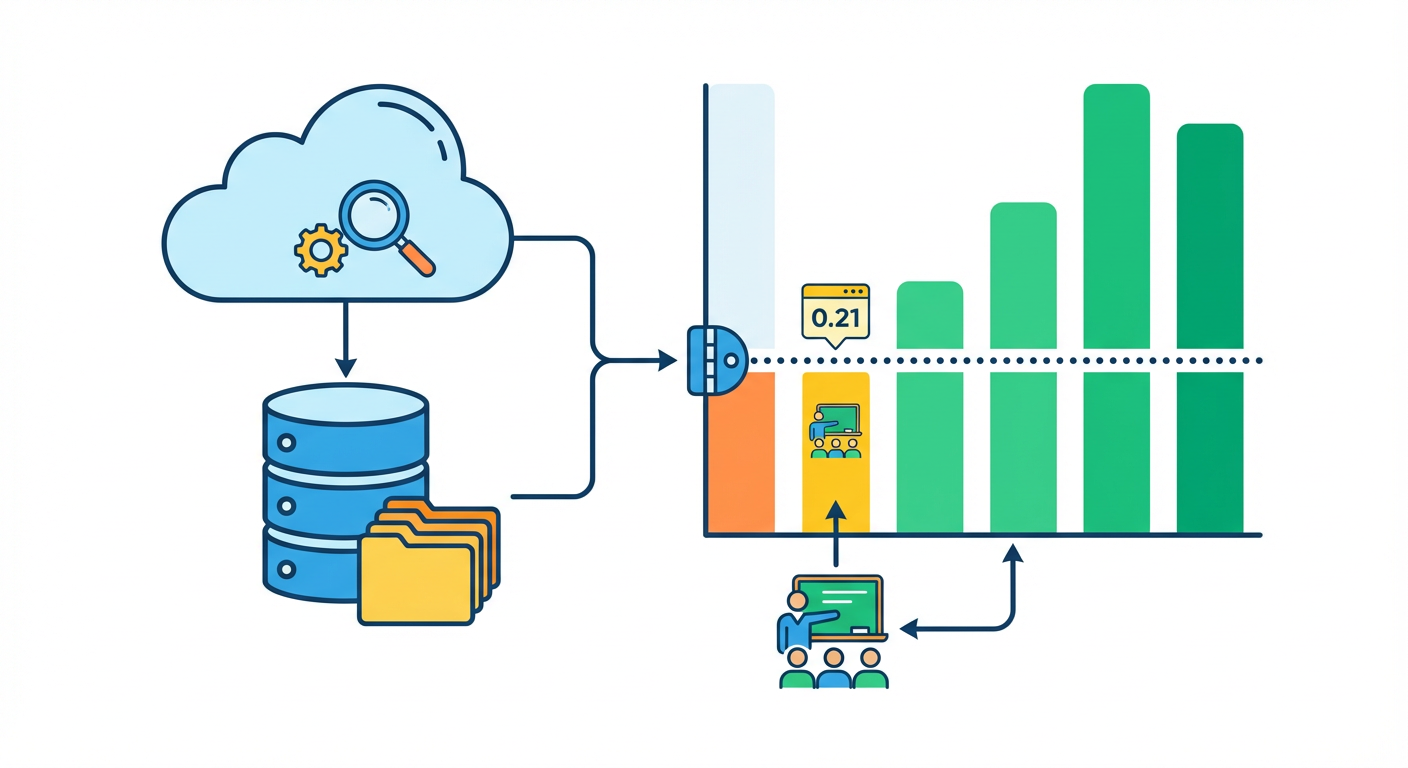
Small class size came in at an effect size of 0.21. Here’s what that means in plain language: it helps, but not as much as most people assume. Hattie has a concept he calls the “hinge point,” an effect size of 0.40. Below that line, the impact is real but modest. Above it, you’re looking at an intervention that creates meaningful, noticeable shifts in student outcomes. Small class size sits below that threshold.

Now, this doesn’t mean small classes don’t matter. It means that simply reducing the number of students in a room, by itself, is not some magic lever that automatically creates better learning. Something else has to happen inside that smaller space.

What Actually Makes a Small Setting Powerful

This is where I get excited, because this is where the science connects to something real teachers know in their bones. The magic in a microschool or a small learning community isn’t just the small class size. It’s what becomes possible because of it.

When I taught calculus to 28 students, I could barely learn everyone’s name before October. I couldn’t track which students confused chain rule with product rule consistently, or who got anxious on tests but thrived with verbal explanations. I couldn’t personalize the pacing or the approach. That’s not a judgment on my effort. It’s a simple fact about cognitive load and time. With smaller groups, teachers can actually see their students. They can notice patterns. They can adjust.

The 2025 microschool research found that self-regulation gains were consistent across networks. Self-regulation improves in environments where adults know you well enough to notice when you’re struggling, where relationships are stable over time, and where the pace allows for genuine interaction. That happens in small settings. But here’s the catch: it only happens if the teaching and curriculum design are intentional. Smallness is necessary but not sufficient.

The Accountability Gap Nobody’s Talking About

Here’s something that keeps me up at night. The Cato Institute analyzed state microschool regulations in 2025 and found that only 11 states had any formal accountability or academic outcome reporting requirements for microschools receiving public funds. Eleven. That means a family in most states could use a scholarship account or voucher to send their child to a microschool, and there would be no standardized way to know whether that student is actually learning.

I’m not saying microschools are unaccountable. Many excellent microschool networks track their own outcomes rigorously. But when public money is flowing toward education, public transparency matters. Not because small schools are inherently suspicious, but because every child deserves oversight. When my daughter goes to school, I want to know there are independent eyes on whether that education is actually working.

The National Microschooling Center research and resources has been publishing data on outcomes, and that’s part of the solution. But it’s voluntary. As microschools become mainstream education for more families, regulation and transparent reporting should follow.

So What’s the Actual Answer?

Small-group education can absolutely deliver on its promise. But it doesn’t automatically. A microschool with brilliant teachers, thoughtful curriculum design, and a strong culture of relationships will outperform a traditional large classroom in many measurable ways. A microschool that’s just a smaller version of traditional school with fewer resources? That’s a different story.

If you’re considering a microschool for your child, don’t just look at the size. Ask about teacher training and retention. Ask what their student outcomes actually are and how they measure them. Ask how they handle students who are struggling. Ask about their approach to social-emotional learning and academic challenge. The smallness opens a door. What matters is what happens through it.

What’s your experience been with smaller learning communities? Whether you’re a parent exploring options, a teacher thinking about this shift, or a student in a microschool right now, I’d love to hear what you’re seeing on the ground. The research tells us part of the story. The lived experience tells us the rest.

What Coursera’s 2025 Data Actually Tells Us About Advising Students Into the Job Market

The Credentials That Are Actually Moving the Needle Right Now

Here’s what stopped me in my tracks when I read through Coursera’s analysis of 148 million learners across more than 100 countries: the four fastest-growing skill categories aren’t what most of us were teaching five years ago. AI literacy. Data storytelling. Cybersecurity fundamentals. Prompt engineering. These aren’t fringe electives anymore. They’re the baseline skills employers are actively hiring for right now.

What Coursera's 2025 Data Actually Tells Us About Advising Students Into the Job Market
What Coursera’s 2025 Data Actually Tells Us About Advising Students Into the Job Market

But here’s the thing that matters more than the trend itself. The Coursera Global Skills Report 2025 shows that learners who actually earned an industry-recognized micro-credential saw a 34% higher job placement rate within six months compared to students who just completed a course and moved on. That’s not a marginal difference. That’s the difference between a portfolio item and a verifiable qualification. When you’re advising a student right now, that number should reshape how you think about what constitutes “completion.”

Illustration for What Coursera's 2025 Data Actually Tells Us About Advising Students Into the Job Market
Illustration for What Coursera’s 2025 Data Actually Tells Us About Advising Students Into the Job Market

The Scale We’re Talking About Is Genuinely Staggering

Google’s Career Certificates program on Coursera just crossed 1 million completions. One million. The top two by volume? Data analytics and project management. Neither one is glamorous, but they’re the connective tissue of how modern organizations actually work. A student who can wrangle data and manage a project timeline can walk into almost any organization and contribute immediately.

Meanwhile, the World Economic Forum’s research should be front and center in every college and career advising conversation. By 2027, automation will displace 85 million jobs. But here’s the counterweight: 97 million new roles requiring hybrid human-AI collaboration will emerge in that same window. The World Economic Forum Future of Jobs 2025 essentially tells us the economy isn’t shrinking. It’s shifting. And it’s shifting fast.

Why Your Students Need to Think Like Systems Designers, Not Just Learners

This is where I get systematic about the advice I’m giving. The old model of “pick a major, get a degree, land a job” is dead. What’s replacing it is more fluid, more intentional, and honestly, more interesting. Your students aren’t just accumulating credentials. They’re building a stack. They need to understand the sequence.

Start with AI literacy. Not advanced machine learning. Basic competency in how AI works, what it can and cannot do, how to work alongside it. That’s the foundation. Then layer in domain-specific skills: data storytelling for analytics, cybersecurity fundamentals for IT or compliance roles, prompt engineering for anyone who wants to multiply their productivity across any field. The order matters because each builds on what comes before.

But here’s what separates students who get hired from those who don’t: they don’t stop at completion. They chase credentials. They put it on LinkedIn. They build a portfolio that proves they can actually do the thing, not just that they watched videos about it.

What Companies Are Telling Us They Need (And It’s Driving Real Change)

LinkedIn’s 2025 Workplace Learning Report found something striking: 89% of learning and development professionals said that proactively building employee skills to fill capability gaps was a top priority. That jumped from 74% in 2022. Companies are moving from a “hire for the role you have” mindset to a “train for the role you’re becoming” mindset, and they’re forming partnerships with platforms like Coursera and edX to make it happen at scale.

What does that mean for you if you’re advising students? It means employers are actively looking for people who know how to learn. People who’ve already demonstrated they can pick up new skills, earn credentials, and apply them. A student who shows up with proof they’ve completed data analytics training isn’t a nice-to-have. They’re a signal that this person understands how to stay relevant in a changing market.

The Sequence That Works: From Now Through Their First Real Job

So if you’re sitting down with a student right now, here’s how I’d think about structuring their path. Month one: build AI literacy. Get comfortable with what’s actually happening in technology. Month two to three: take on a domain-specific skill that aligns with what they want to do. Data analytics if they’re exploring business roles. Cybersecurity if they want tech. Prompt engineering if they want to optimize their work across any field. Month four: earn the credential. Make it official. Not just a completion certificate. An industry micro-credential that means something to an employer.

Then comes the part students sometimes skip: documentation. Update LinkedIn. Build a portfolio. Do a project that shows what they can actually do. Write about what they learned. By month six, they’re not just job-ready. They’re intentional candidates with a clear narrative about why they’re equipped for what’s next.

The system is changing faster than most curricula can keep up with. That’s actually an advantage for the students we advise, because they get to move faster than the system. They can stack credentials. They can prove competency in real time. The students who understand that they’re not waiting for permission to be qualified, but actively building qualifications, are the ones I see landing opportunities.

What’s your experience been with students who’ve earned industry credentials versus those who haven’t? I’d genuinely love to hear what you’re seeing in your advising conversations. Drop a comment or reach out.